
Use this:
When a team shares a single inbox, email becomes a bottleneck. Things get missed, duplicated, or quietly ignored. This project documents how I set up a structured shared inbox system for Tāhuna Consulting — giving a small team a clear process for managing incoming email without dropping the ball.
Problem
Tāhuna Consulting’s general inbox was managed informally — whoever saw an email first would either handle it or leave it for someone else. There was no way to tell what had been dealt with, what was waiting on a response, or what needed escalating.
The result was missed enquiries, duplicated replies, and a team that had quietly stopped trusting the inbox as a reliable channel.
Approach
I approached this as both a process and a documentation problem:
- Mapped how email actually arrived — what types, from whom, and what action each type required
- Identified the failure points: no ownership, no status visibility, no triage process
- Designed a simple label and filter system that made inbox status visible at a glance
- Created a triage guide the team could follow without needing to ask what to do next
- Kept the system simple enough that it wouldn’t require maintenance to maintain
Solution
A structured shared inbox system including:
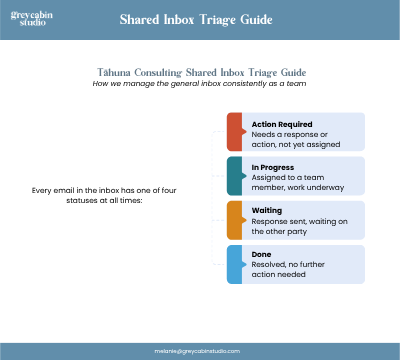
- A label architecture with four status categories: Action Required, In Progress, Waiting, and Done
- Gmail filters to automatically sort and pre-label incoming email by type
- A triage guide covering how to process new email, assign ownership, and close out threads
- A weekly inbox review checklist to catch anything stalling
- A one-page quick reference card for new team members
Outcome
Tāhuna Consulting’s inbox went from an unreliable free-for-all to a system the whole team could trust. Enquiries were responded to consistently, ownership was clear, and nothing required a conversation to figure out who was handling what.
The system was designed to run with a five-minute daily triage and a fifteen-minute weekly review — low enough overhead that the team would actually maintain it.